Brussels
The Day of the JackalBrussels is more than a stop on the Jackal’s route: it is where the practical machinery of his operation takes shape. Its weapons expertise, forged-document trade, and transport links let him prepare in secrecy and move on under a borrowed identity; later, records of his crossings give the French investigation a trail to follow.
A city of specialists and intermediaries
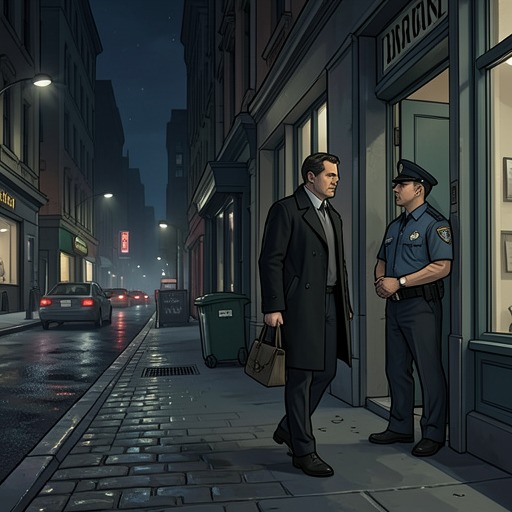
The Jackal first heads for Brussels after a day in Copenhagen that includes buying a Danish book on French churches and cathedrals, lunch in the Tivoli Gardens, and a 3.15 flight. The contrast is characteristic of the city’s role in the novel: an apparently ordinary itinerary can carry someone toward a highly specialized clandestine transaction. In Brussels, a customer’s introduction brings him to M. Goossens, a gunsmith whose discreet business is rooted in an otherwise respectable career.
Goossens has spent thirty years as a trusted employee of Fabrique Nationale at Liège, becoming a leading expert across the company’s range of weapons. His reputation for precision and honesty sits uneasily beside his later work for customers who want their guns untraceable. The gap between public standing and secret trade is not incidental to Brussels’s function in the story. The Jackal does not need an outlaw city openly devoted to crime; he needs skilled people who can keep separate the work they do, the clients they serve, and what they choose not to ask.
The city’s illicit economy also supplies connections beyond the gunsmith. The Jackal suspects Goossens must have access to a forger, but decides to find one independently. Louis, an old contact from Katanga, arranges an introduction. In the early 1960s, Brussels has become an operations base for mercenaries, with more than three hundred former military advisers from the Tshombe regime out of work after the fighting in Katanga. Some possess several sets of identity papers. The Jackal’s access to Louis and this pool of men shows how one clandestine network can lead into another without requiring him to rely on the same intermediary for every part of his plan.
Weapons and concealed workmanship
On July 21, 1963, the Jackal meets Goossens in the gunsmith’s small office. Goossens asks him to remove his dark glasses so they can establish what trust their business association permits, but limits that trust carefully: he does not want to know who the customer is or what he intends to do. The gun will have no serial number. Goossens’s priority is that the weapon cannot be traced back to him, not that he discover the Jackal’s identity.
That arrangement makes Brussels a place of technical preparation as much as personal contact. Goossens’s expertise makes the city useful to a client seeking a weapon, while his insistence on ignorance protects the division between supplier and intended act. After the meeting, the Jackal walks away in bright sunshine, takes a taxi back toward the city centre, and returns to the Hotel Amigo. The ordinary movements through the city sit alongside the concealed transaction without visibly announcing it.
The workshop’s criminal character is also difficult for the Belgian police to prove. They suspect Goossens’s converted-garage forge and workshop, but repeated visits find only equipment for making metal medallions and souvenirs of Brussels statues. On their last visit, Goossens even presents the Chief Inspector with a figurine of Manneken Pis. The decoy is materially plausible because it belongs to the same workshop as his real expertise: the police can see a place equipped for metalwork, yet cannot establish what else it produces or obtain testimony that will hold up in court. His underworld customers protect him, in part because his guns are useful to them.
Forged identity and photographic disguise
Brussels’s reputation for forged identity cards provides another part of the Jackal’s preparation. In a bar off the Rue Neuve, he meets a Belgian forger arranged through Louis. He presents a driving licence in his own name, issued by the London County Council and still valid for several months, and asks for a new front page under his own name because he is banned from driving in Britain. Alongside it, he places a passport in the name of Alexander Duggan. The forger notices that the passport is only three days old and regards the request with suspicion.
The meeting moves from the bar to the forger’s basement photographic studio, more than a mile away. Its shop window advertises passport photographs and displays awkwardly retouched portraits, but the room behind it contains a large trunk of expensive cameras and flash equipment. The forger also has an extensive collection of disguising materials: hair tints and dyes, toupees, wigs, spectacles, and theatrical cosmetics. The two-hour photographic session reveals a second kind of specialist skill beneath the shabby commercial frontage. Halfway through, after working on the Jackal’s face with makeup, the forger hits on the possibility of using the Jackal himself rather than finding a substitute to pose for the photographs, and reaches into the trunk for a wig. The scene makes identity a practical craft, produced through a combination of papers, portraiture, and alteration of appearance.
Transit records become evidence
The Jackal’s later movements through Brussels create records that the investigation can recover. In a subsequent visit, he lands at Brussels National Airport shortly after noon, leaves his three main pieces of luggage in an automatic locker, and carries a hand-grip containing personal effects and materials for a plastered-foot disguise. At the main station he retrieves a fibre suitcase containing the gun from the left-luggage office, using the reclamation slip for a case left there a week earlier. He then takes a room in a small hotel near the station, pays in cash, locks the door, and begins work on the disguise.
He uses that apparent injury to ease his departure. After paying cash for a previously reserved afternoon flight to Milan, he retrieves his three suitcases from the airport locker and checks them with Alitalia. A porter’s concern over the plastered foot helps present the limp as genuine; airport staff assist him onto the aircraft, and other passengers take care not to bump the injured leg. The disguise does not merely change how he looks. It recruits the courtesy of strangers into the work of passing unnoticed.
Later, police archives turn the city’s rail links into a documentary trail. A card records Alexander James Quentin Duggan entering France on the Brabant Express from Brussels on July 22. Another report places Duggan on the Etoile du Nord Express from Paris to Brussels on July 31. A hotel card, carrying the same passport number as the document reported from London, records a stay near the Place de la Madeleine from July 22 through July 30. Brussels is therefore present both at the point of preparation and in the administrative evidence that allows investigators to reconstruct travel across borders.
Narrative significance
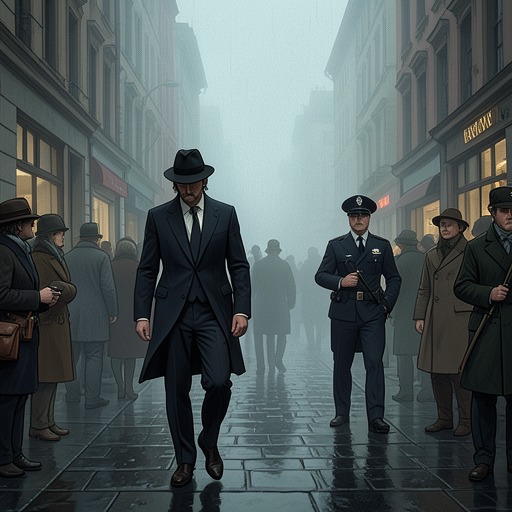
Brussels works through the tension between visibility and concealment. The gunsmith’s workshop is inspected but not exposed; the photographer’s shabby storefront hides professional equipment; a busy mercenary milieu makes multiple identities available; airport and railway formalities record journeys without immediately revealing their purpose. The Jackal takes advantage of the same urban systems that later help identify his route: introductions, luggage services, tickets, and routine passenger records.
The city also marks the difference between assembling an operation and understanding it. Goossens can ensure that a weapon carries no serial number, and the forger can help translate appearance into a usable identity, but neither needs to know the whole plan. For the police, by contrast, scattered documents must be brought together: a name in a frontier report, a passport number on a hotel card, and a return journey on another train. Brussels is where the Jackal’s preparations gain material form, and where the movement that was meant to stay anonymous begins, retrospectively, to leave a trace.